
Quick Answer
A WordPress developer is a professional who designs, builds, optimizes, and maintains websites using WordPress. Beyond simply creating pages, they handle website architecture, performance, SEO structure, security, scalability, and long-term technical stability. Their role is not just to make a website look good—but to ensure it performs well, generates leads, ranks on search engines, and supports business growth over time.
In today’s digital environment, a website is no longer just an online presence—it has become a core business asset.
Many business owners assume a website is mainly about design.
But after working with businesses across different industries, one pattern appears repeatedly: websites that look impressive often fail to generate results because the technical foundation was never built correctly.
In reality, the long-term success of a website depends on:
- Speed and performance
- SEO structure
- User experience
- Conversion optimization
- Technical stability
This is where a WordPress developer becomes extremely important.
They don’t just build websites — they build systems that support visibility, engagement, and business growth.
One thing many businesses realize too late is that poor website structure creates hidden problems over time. Slow loading pages, plugin conflicts, SEO issues, broken mobile layouts, and low conversion rates often originate from weak development decisions made in the beginning.
A website might work perfectly during launch, but if scalability, performance, and maintenance are ignored, problems often appear months later when traffic increases or new features are added.
This is one of the biggest differences between simply creating a website and professionally developing one.
What a WordPress Developer Actually Does?
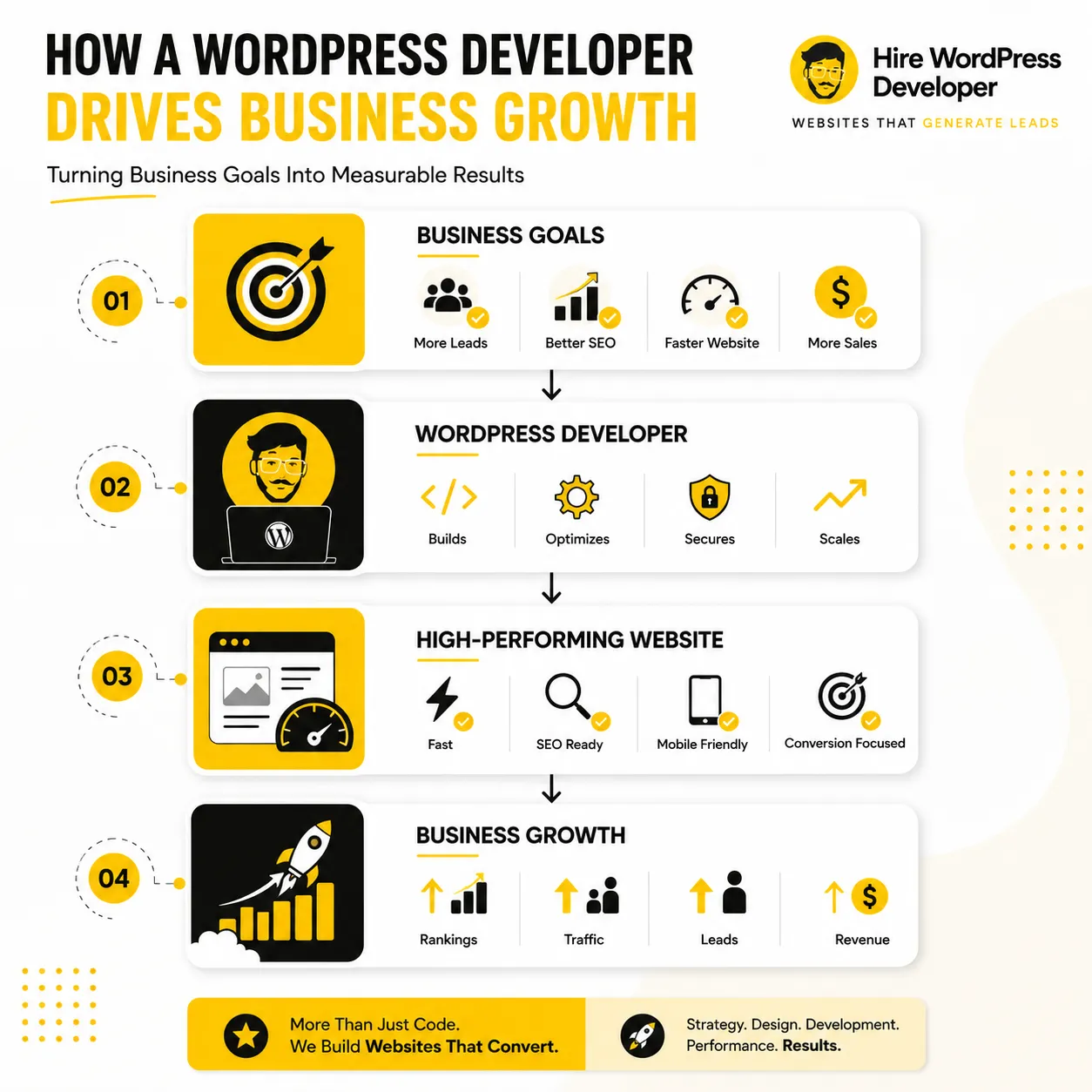
At a deeper level, a WordPress developer transforms a business idea into a functional, scalable, and optimized digital platform.
This includes:
- Designing the structure of the website
- Developing functional pages and custom features
- Optimizing performance across devices
- Maintaining long-term security and stability
- Structuring the website for SEO and conversions
They work across both:
Front-end → What users see and interact with
Back-end → How the website functions internally
In simple terms:
A WordPress developer converts business goals into a working digital system.
A good developer also understands that website development is not only technical work. It directly affects how users behave on the website.
For example:
- Slow websites increase bounce rates
- Poor navigation reduces conversions
- Weak mobile optimization hurts engagement
- Unoptimized architecture impacts SEO visibility
This is why development quality often affects marketing performance more than most businesses expect.
In practical business scenarios, marketing campaigns frequently receive the blame when lead generation is poor. However, the actual problem is often the website itself.
Consider this example:
Two companies may spend the same amount on SEO or advertising.
One website loads in under two seconds, guides visitors smoothly toward a call-to-action, and works perfectly on mobile devices.
The other loads slowly, contains confusing navigation, and forces users to search for basic information.
Even with identical marketing efforts, the first website will usually generate significantly better results because the underlying user experience is stronger.
This is why experienced WordPress developers think beyond pages and design elements. They focus on how visitors move through the website, where friction occurs, and how technical decisions influence business outcomes.
A skilled developer typically balances five critical areas simultaneously:
- Performance
- User Experience
- SEO Readiness
- Conversion Optimization
- Long-Term Scalability
When these areas work together, a website becomes more than a digital brochure—it becomes a business asset capable of generating leads, sales, and long-term growth.
One important observation many businesses overlook is that users rarely notice good development directly.
Visitors do not usually compliment:
- Efficient database architecture
- Optimized code structure
- Proper caching systems
- Security hardening
- Clean server configurations
However, they immediately notice when these things are missing.
They experience:
- Slow loading pages
- Broken functionality
- Mobile usability issues
- Security warnings
- Frustrating user journeys
In other words, great WordPress development often becomes invisible because everything simply works as expected.
That reliability is one of the most valuable outcomes a professional developer provides.
Main Responsibilities of a WordPress Developer
1. Website Development (Core Responsibility)
- Build WordPress websites from scratch or redesign existing ones
- Structure pages around business goals
- Ensure mobile responsiveness
- Create scalable website architecture
A skilled developer does not simply “create pages.”
They build conversion-focused systems designed around user behavior and business objectives.
For example:
- A lead generation website requires strategic CTA placement and form optimization
- An e-commerce website requires smooth navigation and checkout flow optimization
- A service business website requires trust-focused structure and local SEO alignment
Many poorly performing websites fail because they were designed visually first and strategically second.
One thing experienced developers often notice is that businesses naturally focus on homepage design because it is the most visible part of a website. However, visitors rarely make decisions based on design alone.
They evaluate factors such as:
- Ease of navigation
- Speed
- Trustworthiness
- Mobile usability
- Availability of information
A well-developed website guides users toward action naturally instead of forcing them to search for information.
For instance, if a visitor lands on a service page, they should immediately understand:
- What the business offers
- Why they should trust the company
- What action to take next
When these elements are missing, even visually impressive websites can struggle to generate leads.
This is why experienced WordPress developers spend significant time planning website structure before writing a single line of code.
The goal is not simply to launch a website.
The goal is to build a platform that supports business growth for years.
2. Front-End Development
- Design UI/UX for higher engagement
- Ensure responsiveness across all devices
- Improve visual hierarchy and readability
- Optimize interaction flow
Poor front-end experience often causes users to leave within seconds.
Optimized front-end experience can improve:
- Engagement
- Session duration
- Conversion rates
- User trust
One common issue developers frequently notice is that visually attractive websites sometimes perform poorly because they prioritize animations and effects over usability and speed.
A balanced front-end focuses on both aesthetics and performance.
Many business owners assume front-end development is primarily about making a website look attractive.
In reality, effective front-end development is largely about communication.
Every visual element should help visitors understand information faster and move through the website more efficiently.
For example:
A cluttered page with too many colors, buttons, and animations may look creative, but it often creates decision fatigue.
A clean and organized layout usually performs better because users can quickly identify:
- Key information
- Important services
- Contact options
- Calls-to-action
From a usability perspective, simplicity often outperforms complexity.
One interesting observation from real-world projects is that removing unnecessary design elements frequently improves engagement metrics rather than reducing them.
Users generally value clarity more than visual complexity.
This is especially true on mobile devices, where screen space is limited and user attention spans are shorter.
A skilled WordPress developer ensures that every design decision supports the user experience rather than distracting from it.
3. Back-End Development
- Manage server-side logic and databases
- Structure scalable site architecture
- Ensure smooth website functionality
- Improve long-term technical reliability
This is what largely determines:
- Scalability
- Reliability
- Technical stability
- Long-term performance
Back-end development is one of the most overlooked aspects of WordPress websites because users rarely see it directly. However, it often determines whether a website can handle future growth without technical breakdowns.
Many websites become unstable over time because they were never built with scalability in mind.
Think of back-end development as the foundation of a building.
Visitors may admire the design and appearance, but the strength of the structure determines whether it remains stable over time.
The same principle applies to websites.
A website may function perfectly when it receives a few hundred visitors per month. But as traffic grows, weaknesses in the architecture often become visible.
Common symptoms include:
- Slow database queries
- Server overload
- Broken functionality
- Plugin conflicts
- Unexpected downtime
These issues are rarely caused by WordPress itself.
In many cases, they result from shortcuts taken during development.
Experienced developers build websites with future growth in mind.
This includes:
- Efficient database structures
- Proper code organization
- Scalable hosting environments
- Optimized resource usage
One thing many businesses discover after scaling is that rebuilding an unstable website is significantly more expensive than building it correctly from the beginning.
That is why strong back-end development should be viewed as a long-term investment rather than a technical expense.
4. Theme & Plugin Development (Beyond Basic Usage)
Most beginners install themes and plugins.
A WordPress developer goes much deeper than that.
Developers:
- Customize themes for flexibility and speed
- Reduce unnecessary plugin dependency
- Build or modify plugins for custom functionality
- Prevent compatibility conflicts
Real-World Insight
A large percentage of slow WordPress websites are not caused by WordPress itself.
They are caused by:
- Excessive plugins
- Bloated themes
- Poor hosting configuration
- Unoptimized third-party scripts
Many businesses unknowingly install 20–40 plugins over time just to compensate for weak website architecture. This often creates performance, security, and maintenance problems later.
A good developer focuses on building lean and efficient systems instead of stacking unnecessary tools.
One of the most common situations developers encounter involves websites that have gradually accumulated plugins over several years.
A business might install:
- One plugin for forms
- Another for popups
- Another for analytics
- Another for SEO
- Another for speed optimization
- Another for design enhancements
Individually, each plugin seems harmless.
Collectively, they can create a complex system that becomes difficult to maintain.
Plugin overload often leads to:
- Slower page speeds
- Increased security risks
- Higher maintenance requirements
- Compatibility issues after updates
A skilled WordPress developer evaluates whether functionality truly requires another plugin or whether it can be implemented more efficiently through custom development.
The same principle applies to themes.
Many pre-built themes include hundreds of features that businesses never use. While these features may appear attractive initially, they often introduce unnecessary code that impacts performance.
From a performance perspective, a streamlined website with only the required functionality usually performs better than a heavily customized website built on excessive third-party dependencies.
One practical rule experienced developers follow is simple:
Every plugin, script, or feature should justify its existence.
If it does not contribute meaningful value to the business or user experience, it may be creating more problems than benefits.
This approach helps create websites that remain fast, secure, and manageable as the business grows.
5. Website Performance Optimization
This is one of the most underestimated responsibilities of a WordPress developer.
Developers optimize:
- Page load speed
- Core Web Vitals
- Image compression
- CSS and JavaScript loading
- Database efficiency
- Caching systems
Faster websites typically:
- Rank better on search engines
- Improve user experience
- Increase conversions
- Reduce bounce rates
One important observation many businesses overlook is that website speed affects trust perception. Users often associate slow websites with low credibility, even subconsciously.
In competitive industries, even small speed improvements can impact lead generation and sales performance.
Many website owners assume a one- or two-second delay is insignificant.
However, user behavior often tells a different story.
When visitors arrive on a website, they immediately begin forming impressions about the business. Before reading content, checking services, or exploring products, they experience the website’s speed.
A slow-loading website can create several negative perceptions:
- The business may not be professional
- The website may not be secure
- The information may be outdated
- The company may not be trustworthy
These judgments happen surprisingly fast.
In practical projects, performance improvements often produce measurable business benefits without changing any marketing campaigns.
For example:
A website that loads in six seconds may lose a significant portion of visitors before they even view the content.
Reducing load time to two seconds can immediately improve:
- User engagement
- Lead submissions
- Session duration
- Page views
This is why experienced developers treat performance as a business metric rather than simply a technical metric.
A good WordPress developer continuously looks for opportunities to improve efficiency through:
- Better hosting configuration
- Optimized image delivery
- Efficient code structure
- Smart caching implementation
- Reduced unnecessary scripts
Performance optimization is not a one-time task.
It is an ongoing process that directly affects user satisfaction, SEO visibility, and revenue generation.
6. SEO & Technical Optimization
A WordPress developer directly impacts SEO through technical implementation.
This includes:
- Structuring clean code
- Implementing schema markup
- Optimizing URLs and internal linking
- Improving crawlability
- Enhancing mobile performance
- Reducing technical SEO issues
SEO is not only about content.
Technical structure plays a major role in how search engines understand and rank a website.
For example:
- Poor code structure can slow indexing
- Weak internal linking reduces discoverability
- Heavy scripts can damage Core Web Vitals
- Broken mobile layouts hurt rankings
A properly developed WordPress website creates a stronger SEO foundation before content marketing even begins.
One of the biggest misconceptions businesses have is that SEO starts when content is published.
In reality, SEO begins much earlier.
The way a website is developed influences how efficiently search engines can crawl, understand, and evaluate content.
Consider two websites publishing equally valuable content.
One website has:
- Clean architecture
- Fast page speeds
- Logical navigation
- Mobile-friendly design
- Structured data implementation
The other suffers from:
- Slow loading times
- Technical errors
- Poor internal linking
- Mobile usability issues
Even with identical content quality, the technically optimized website usually has a significant advantage.
This is why experienced WordPress developers often collaborate closely with SEO professionals.
Their work creates the technical environment that allows SEO efforts to perform at their highest potential.
Another practical observation is that many ranking problems are not content problems at all.
They are technical problems disguised as SEO problems.
Issues such as:
- Crawl inefficiencies
- Indexing limitations
- Broken page structures
- Poor Core Web Vitals
can quietly reduce visibility even when content quality is strong.
A skilled WordPress developer helps eliminate these hidden obstacles before they affect growth.
7. Website Maintenance & Security
After launch, the real work begins.
Developers manage:
- Regular updates
- Security hardening
- Backups and recovery
- Malware prevention
- Bug fixing
- Performance monitoring
Most hacked or broken WordPress websites lack proper maintenance.
One common mistake businesses make is abandoning updates for months or years. Over time, outdated plugins, themes, and PHP versions become major security risks.
Professional maintenance helps prevent:
- Plugin conflicts
- Downtime
- Data loss
- Security vulnerabilities
- Performance degradation
A well-maintained website remains stable for years instead of constantly requiring emergency fixes.
Many business owners view website launch as the finish line.
In reality, it is closer to the starting line.
Websites operate in constantly changing environments.
Over time:
- Plugins receive updates
- Security vulnerabilities emerge
- Hosting technologies evolve
- Browser standards change
- Search engine requirements shift
Without maintenance, even a well-developed website can gradually become unstable.
One recurring pattern developers encounter is businesses contacting them only after a major issue occurs.
Examples include:
- Website crashes
- Malware infections
- Lost customer data
- Broken forms
- Unexpected downtime
At that point, repairs are often more expensive and stressful than preventive maintenance would have been.
A proactive maintenance strategy focuses on preventing problems before users ever notice them.
This typically includes:
- Scheduled backups
- Security monitoring
- Performance audits
- Compatibility testing
- Update management
From a business perspective, maintenance is similar to servicing a vehicle.
Regular maintenance may seem unnecessary when everything is functioning properly, but neglect eventually leads to larger and more costly problems.
A professional WordPress developer helps ensure that a website remains secure, stable, and reliable long after launch.
8. Translating Business Goals into Technical Execution
This is one of the most valuable responsibilities of a WordPress developer.
A skilled developer:
- Understands the business model
- Aligns website structure with user intent
- Builds conversion-focused user flows
- Creates scalable technical systems
Examples:
Lead generation website → CTA placement + form optimization + landing page structure
E-commerce website → checkout optimization + speed improvements + product filtering
Service business website → local SEO structure + trust elements + conversion-focused design
This is where experienced developers stand out from basic website builders.
They do not simply build pages.
They build systems designed to support measurable business outcomes.
One reason some websites outperform competitors despite having similar products or services is that the technical implementation aligns closely with business objectives.
For example:
A law firm website and an e-commerce store may both use WordPress, but their goals are completely different.
The law firm may prioritize:
- Consultation requests
- Trust building
- Local SEO visibility
- Lead generation
The e-commerce store may prioritize:
- Product discovery
- Checkout efficiency
- Inventory management
- Customer retention
A skilled WordPress developer understands these differences and develops the website accordingly.
Rather than applying the same template to every project, they adapt the technical structure to support specific business goals.
This often involves asking questions such as:
- What action should visitors take?
- What information influences buying decisions?
- Where are users dropping off?
- How will the business scale in the future?
The answers help shape everything from page layouts to technical architecture.
One insight many businesses discover after redesign projects is that better results rarely come from visual changes alone.
The biggest improvements often occur when technical decisions are aligned with customer behavior and business objectives.
That alignment is what transforms a website from a marketing expense into a business asset.
A professional WordPress developer bridges the gap between business strategy and technical execution, ensuring that every element of the website contributes toward measurable growth.
WordPress Developer vs Designer vs Agency
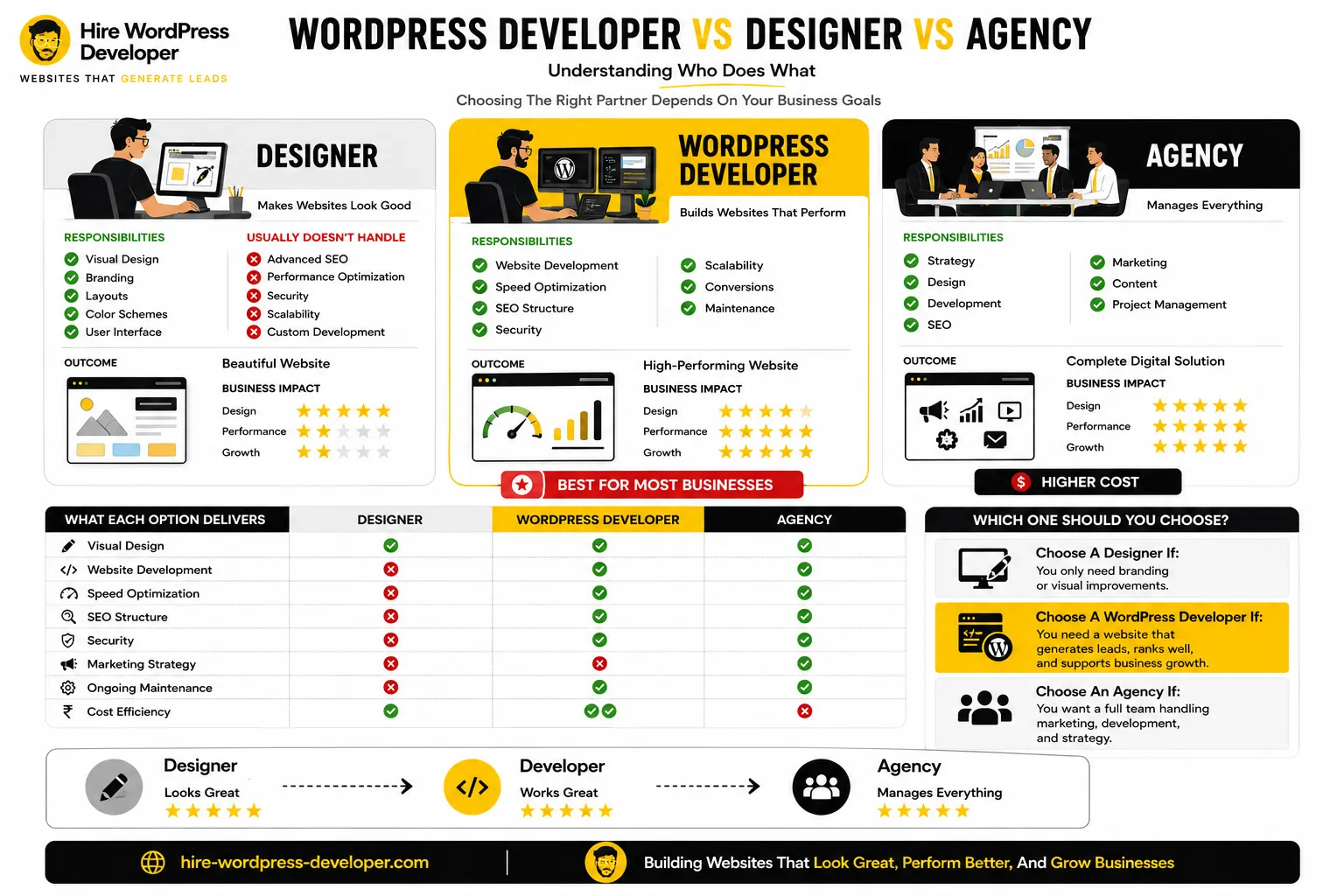
| Role | Core Function |
|---|---|
| WordPress Developer | Functionality, performance, scalability |
| Designer | Visual appearance |
| Agency | Combined service (usually higher cost, broader management) |
Key Difference:
A developer focuses on how the website functions, performs, scales, and converts—not just how it looks visually.
Many businesses confuse design quality with website effectiveness.
In reality, a visually impressive website can still fail if the technical structure, speed, SEO, and conversion flow are weak.
To better understand the difference, think of a website like a commercial building.
A designer determines:
- How the building looks
- How visitors experience the space
- The visual identity and branding
A WordPress developer determines:
- How the building operates
- Whether the infrastructure can support growth
- Whether systems function reliably over time
An agency often combines both while also managing:
- Project planning
- Marketing strategy
- Content creation
- Ongoing support
The challenge is that many businesses hire based solely on design portfolios.
While design is important, business performance often depends more heavily on:
- Speed
- User flow
- Conversion paths
- SEO structure
- Technical reliability
For example:
A beautiful website that loads slowly and frustrates visitors may generate fewer leads than a simpler website built around user behavior and performance.
This is why many successful businesses prioritize functionality and business outcomes alongside design quality.
The best results usually occur when design, development, and strategy work together rather than independently.
When Do You Need a WordPress Developer?
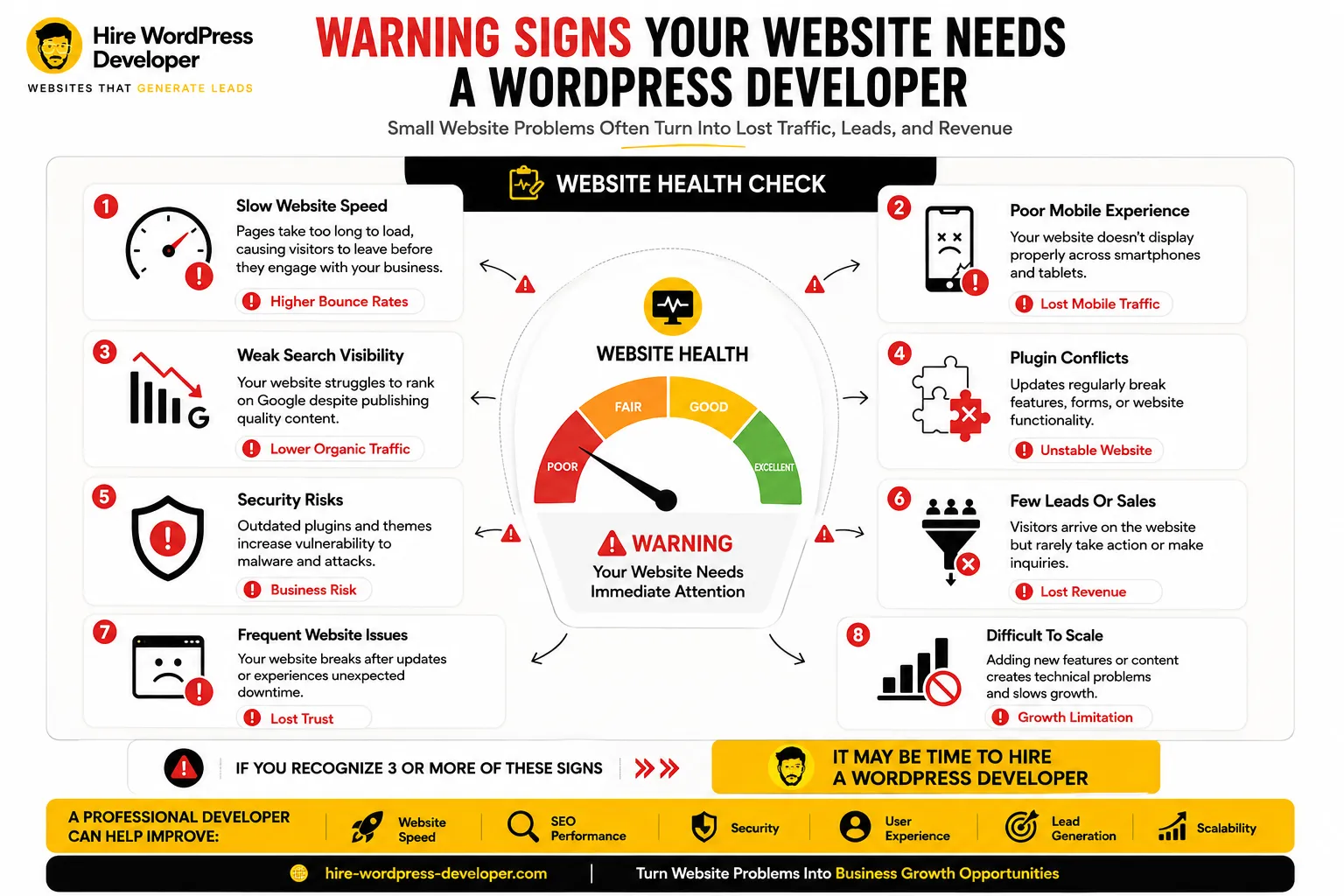
You should consider hiring a WordPress developer when:
- You want your website to generates leads or sales
- Your current website feels slow or outdated
- You need custom features or integrations
- Your SEO performance is weak
- You want to improve user experience and conversions
- You plan to scale your business online
- Your website frequently breaks after updates
One important thing many businesses discover later is that fixing a poorly built website often costs more than building it properly from the beginning.
Many business owners initially assume they only need a developer when something breaks.
However, the highest-value projects often happen before problems appear.
You may need a WordPress developer if: Your Website Is Growing
As traffic increases, websites often require:
- Better hosting architecture
- Database optimization
- Advanced caching
- Improved scalability
What worked for a small business website may not work once thousands of visitors arrive each month.
You Need Custom Functionality
Many businesses eventually outgrow standard templates and plugins.
Examples include:
- Custom booking systems
- Membership portals
- CRM integrations
- Advanced lead management systems
- Custom dashboards
A developer can build solutions tailored to specific business requirements rather than forcing the business to adapt to software limitations.
Your Marketing Results Have Stalled
Sometimes the issue is not marketing.
It is the website.
Common warning signs include:
- High bounce rates
- Low conversion rates
- Slow loading pages
- Poor mobile performance
- Weak user engagement
In these situations, improving the website often delivers better results than increasing advertising budgets.
A skilled developer helps identify and resolve the technical barriers preventing growth.
What Results a Good WordPress Developer Improves?
A skilled WordPress developer can directly influence business performance.
1. Website Speed
→ Faster load times improve user experience and search visibility.
Speed improvements often create ripple effects across multiple areas of a business.
Benefits may include:
- Higher engagement
- Lower bounce rates
- Better conversion rates
- Improved SEO performance
Users are more likely to stay on a website when pages respond quickly.
2. SEO Rankings
→ Better technical structure improves indexing and discoverability.
Search engines evaluate far more than content.
Technical improvements can help search engines:
- Crawl pages more efficiently
- Understand content better
- Index pages faster
- Deliver stronger mobile experiences
This creates a stronger foundation for long-term organic growth.
3. Conversion Rate
→ Optimized layouts increase leads and sales.
A developer influences conversion performance through:
- User flow optimization
- Strategic call-to-action placement
- Faster page loading
- Mobile usability improvements
- Technical reliability
Small improvements in conversion rates can produce significant business impact over time.
For example:
If a website converts 2% of visitors today and improves to 3%, that represents a 50% increase in lead generation without increasing traffic.
4. User Experience
→ Smooth navigation improves engagement and retention.
Visitors should never feel confused about:
- Where to go
- What to do next
- How to contact the business
- How to find information
A well-developed website removes friction and helps users achieve their goals quickly.
One practical observation from real-world projects is that users often leave websites not because products or services are poor, but because the website creates unnecessary obstacles.
Reducing those obstacles frequently improves performance more than adding new features.
5. Long-Term Scalability
→ Proper architecture prevents future technical issues.
Scalability determines whether a website can grow alongside the business.
Examples include:
- Handling higher traffic volumes
- Supporting new features
- Expanding content libraries
- Managing larger databases
- Integrating additional systems
A website built with scalability in mind avoids expensive rebuilds later.
Real-World Observation
Many businesses struggle not because their marketing is weak—but because their website infrastructure limits performance, trust, and conversion potential.
Marketing attracts visitors.
The website determines what happens after they arrive.
That is why experienced developers often have a direct impact on revenue generation, customer acquisition, and long-term growth.
Types of WordPress Developers
1. Front-End Developer
Focus:
- UI/UX
- Responsiveness
- Visual interaction
- User engagement
Front-end developers specialize in the user-facing side of websites.
Their work influences how visitors experience:
- Navigation
- Design
- Content presentation
- Interactive elements
A strong front-end developer understands both aesthetics and usability.
The goal is not simply to make website pages look attractive.
The goal is to create experiences that encourage engagement and action.
2. Back-End Developer
Focus:
- Servers
- Databases
- Functionality
- Technical architecture
Back-end developers manage the systems users rarely see but constantly depend on.
Their responsibilities often include:
- Database management
- Server configuration
- Custom functionality
- Security implementation
- Performance optimization
A well-built back-end helps ensure stability, scalability, and long-term reliability.
Without strong back-end development, even the best-designed websites can encounter serious operational issues.
3. Full-Stack Developer
Handles Both:
- Front-end
- Back-end
Most modern freelance WordPress developers today operate as full-stack professionals because businesses increasingly prefer developers who can manage complete website systems efficiently.
A full-stack developer can:
- Design user experiences
- Build custom functionality
- Optimize performance
- Manage security
- Implement SEO best practices
For many small and medium-sized businesses, hiring a full-stack developer provides the most efficient balance between cost, flexibility, and expertise.
However, larger organizations sometimes maintain specialized front-end and back-end teams for highly complex projects.
The best choice depends on:
- Project complexity
- Budget
- Growth plans
- Technical requirements
Regardless of specialization, the most valuable developers understand how technical decisions influence business outcomes.
That broader perspective is what separates strategic developers from individuals who simply build websites.
What a Good WordPress Developer Improves Behind the Scenes
This is what most people never notice directly:
- Clean code structure
- Optimized plugin stack
- Proper hosting configuration
- Image and script optimization
- Mobile-first performance tuning
- Security hardening
- Database optimization
- CDN and caching configuration
- SEO-friendly architecture
These invisible optimizations often determine whether a website succeeds long term.
In many cases, users judge a business within seconds based on website speed, responsiveness, and usability—even before reading the actual content.
One of the most interesting aspects of professional WordPress development is that some of the most valuable work happens where visitors never look.
Customers rarely notice:
- Efficient database queries
- Server-side optimizations
- Proper caching rules
- Clean code architecture
- Security layers
However, they immediately notice the consequences when these elements are missing.
For example:
Poor database optimization may lead to:
- Slow product searches
- Delayed page loading
- Website crashes during traffic spikes
Weak hosting configuration may result in:
- Frequent downtime
- Unstable performance
- Lost business opportunities
Unoptimized scripts may create:
- Slow mobile experiences
- Poor Core Web Vitals
- Reduced SEO visibility
A skilled developer continuously improves these technical layers because they directly influence user satisfaction and business performance.
The Hidden Performance Layer
Many website owners focus only on visible features.
Experienced developers often focus equally on invisible infrastructure.
This includes:
- Server response times
- Resource allocation
- Asset delivery
- Database efficiency
- Code maintainability
The reason is simple:
A website that performs well internally usually performs better externally.
Over time, these improvements compound and contribute to:
- Better rankings
- Higher conversions
- Improved scalability
- Reduced maintenance costs
The strongest websites are rarely the most complicated.
They are often the most efficiently engineered.
Common Misconceptions
“WordPress developers just install themes”
Reality:
Professional developers customize, optimize, and engineer the complete system around business goals, performance, SEO, and scalability.
Installing a theme is often one of the smallest parts of the job.
The real value comes from understanding:
- How the website should function
- How users interact with it
- How it can scale over time
- How it supports business objectives
Many businesses initially assume development ends once a theme is installed.
In reality, that is often where professional development begins.
A theme provides a starting point.
The developer transforms it into a customized business solution.
“Anyone can build a website”
Reality:
Anyone can technically create a website.
But poorly built websites often lead to:
- Slow performance
- Low conversions
- Plugin conflicts
- SEO problems
- Weak mobile experience
- Security vulnerabilities
The difference between a basic website and a professionally developed website becomes more visible as the business grows.
Website builders and drag-and-drop tools have made website creation easier than ever.
However, creating a website and creating an effective website are two different things.
Many businesses discover this after encountering issues such as:
- Traffic growth causing slowdowns
- Conversion rates remaining low
- Technical limitations preventing expansion
- Maintenance becoming increasingly difficult
A website can exist online without supporting business growth.
Professional development focuses on ensuring that the website contributes to measurable outcomes.
“Design is the most important part”
Reality:
Design matters, but structure and performance usually determine long-term results.
A visually attractive website that loads slowly or converts poorly can still damage business growth.
Good design attracts attention.
Good development helps turn attention into action.
Consider two scenarios:
Website A
- Stunning design
- Heavy animations
- Slow loading speed
- Confusing navigation
Website B
- Clean design
- Fast performance
- Clear user flow
- Conversion-focused structure
In many industries, Website B generates better business results despite appearing simpler.
This is because users prioritize convenience, speed, and clarity more than most businesses realize.
The highest-performing websites typically combine:
- Strong design
- Strong development
- Strong business strategy
Focusing exclusively on any one area often creates limitations elsewhere.
Is Hiring a WordPress Developer Worth It?
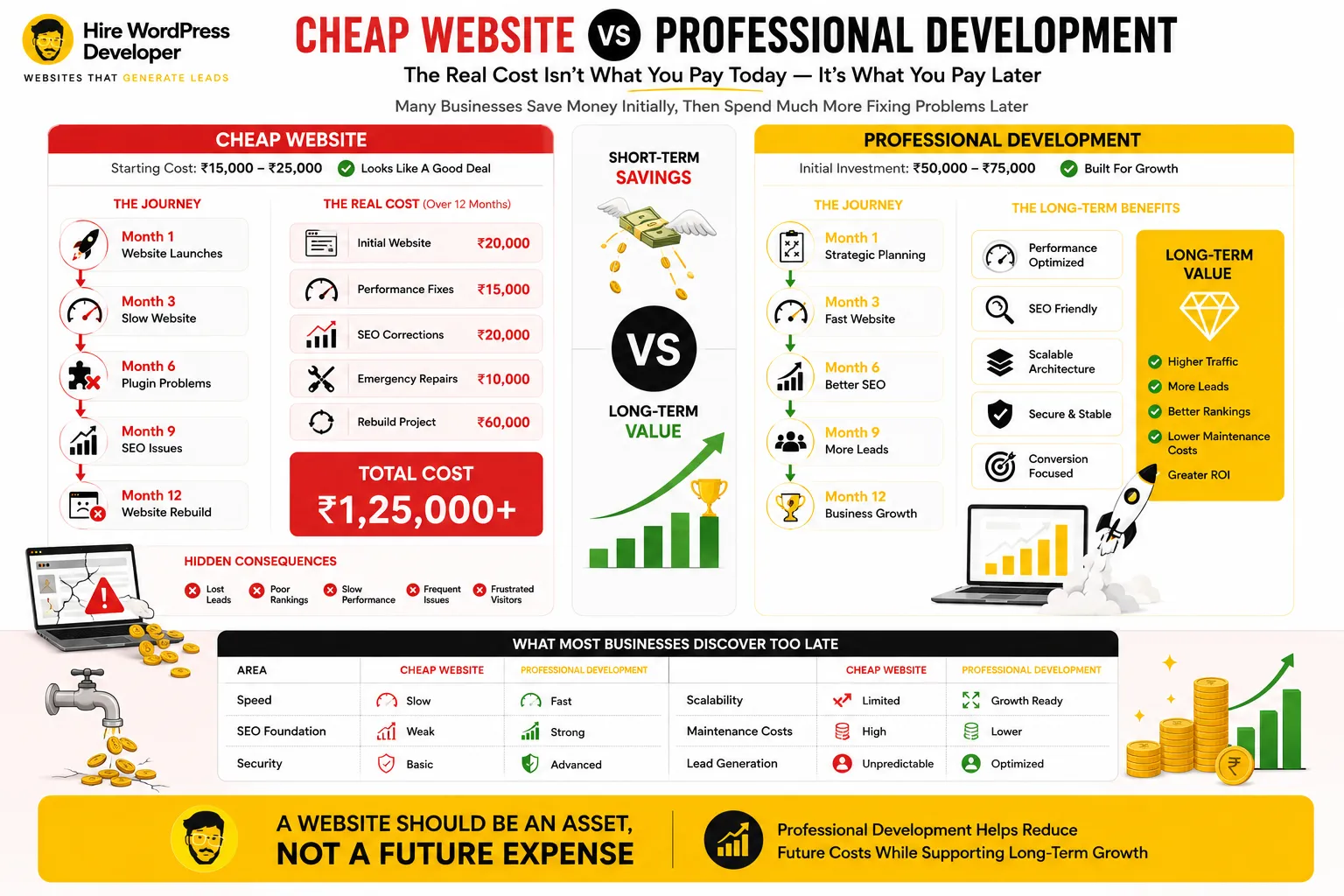
Yes — because an experienced developer can:
- Save time
- Prevent technical problems
- Improve performance
- Strengthen SEO foundations
- Increase scalability
- Reduce future maintenance costs
A website built properly once is usually far cheaper than repeatedly fixing a poorly structured website later.
Many businesses initially choose cheaper solutions, only to rebuild the entire website again after performance or scalability issues appear.
One practical lesson repeatedly observed across website projects is that technical debt accumulates quickly.
Short-term decisions such as:
- Choosing low-quality themes
- Installing excessive plugins
- Ignoring performance optimization
- Skipping proper architecture planning
may reduce costs initially.
However, they often create larger expenses later.
Common examples include:
- Full website rebuilds
- Emergency security fixes
- Migration costs
- Lost SEO rankings
- Revenue loss from downtime
An experienced developer helps avoid these problems before they occur.
Cost vs Long-Term Value
Many businesses evaluate developers based solely on upfront pricing.
A more useful question is:
How much value will the website generate over the next three to five years?
If better development improves:
- Lead generation
- Conversion rates
- Search visibility
- User retention
the return on investment can significantly exceed the initial development cost.
A professionally built website should not be viewed as an expense alone.
It should be viewed as a business asset capable of producing long-term returns.
Why WordPress is the Most Preferred Platform?
WordPress remains one of the most dominant website platforms because it offers:
- Flexibility
- Scalability
- SEO-friendly architecture
- Large plugin ecosystem
- Ease of management
- Customization capabilities
However, WordPress performance depends heavily on how the website is developed and maintained.
A properly optimized WordPress website can compete with highly custom-built platforms in terms of speed, SEO, and scalability.
One reason WordPress has remained relevant for so many years is its ability to adapt to different business requirements.
Today, WordPress powers:
- Small business websites
- Corporate websites
- E-commerce stores
- Membership platforms
- Educational portals
- Media publications
- SaaS marketing websites
Few platforms offer this level of flexibility while remaining accessible to non-technical users.
Why Businesses Continue Choosing WordPress
Business owners often choose WordPress because it provides a balance between:
- Ease of use
- Cost efficiency
- Customization
- Long-term scalability
Unlike many closed platforms, WordPress gives businesses greater control over:
- Hosting
- Functionality
- Integrations
- Data ownership
- Future expansion
This flexibility becomes increasingly valuable as businesses grow.
A Common Misunderstanding About WordPress
Some people assume WordPress is only suitable for small websites.
In reality, many high-traffic and enterprise-level websites use WordPress successfully.
The determining factor is rarely the platform itself.
The determining factor is how well the website is developed, optimized, and maintained.
When implemented correctly, WordPress can support:
- Millions of monthly visitors
- Large content libraries
- Complex integrations
- Advanced business requirements
This is one of the primary reasons WordPress continues to remain the preferred choice for businesses worldwide.
Why Choose hire-wordpress-developer.com?
If your goal is long-term business growth—not just website design—this platform focuses on:
- Performance-first development
- SEO and conversion optimization
- Business-focused website structure
- Affordable freelance solutions
- Scalable website systems
The objective is not simply to launch a website.
The goal is to build a high-performing digital asset that supports visibility, lead generation, and business growth over time.
Many businesses reach a point where they realize that having a website and having a website that produces results are two very different things.
A website should contribute to business objectives such as:
- Generating qualified leads
- Increasing sales opportunities
- Building trust and credibility
- Improving search visibility
- Supporting long-term scalability
That requires more than attractive design.
It requires strategic development decisions that align technology with business goals.
A Business-First Development Approach
Rather than treating website development as a technical task alone, the focus is placed on how the website contributes to measurable outcomes.
This often involves improving:
- Website speed
- User experience
- Conversion pathways
- Technical SEO foundations
- Scalability planning
The result is a website that not only looks professional but also performs effectively in competitive markets.
Long-Term Thinking Instead of Short-Term Fixes
One common issue many businesses face is repeatedly fixing the same website problems.
Examples include:
- Slow loading pages
- Plugin conflicts
- Poor mobile experiences
- Technical SEO issues
- Frequent maintenance problems
Addressing symptoms may provide temporary relief.
Addressing the underlying architecture creates long-term stability.
That philosophy is what separates strategic development from short-term website fixes.
Frequently Asked Questions (FAQ)
1. What skills does a WordPress developer have?
A professional WordPress developer usually works with:
- HTML
- CSS
- JavaScript
- PHP
- Databases
- WordPress ecosystem tools and plugins
Many experienced developers also understand:
- SEO
- Performance optimization
- UX principles
- Hosting environments
- Security systems
The most effective developers combine technical knowledge with business understanding.
This allows them to create websites that not only function correctly but also support growth objectives.
2. Can a WordPress developer build e-commerce websites?
Yes.
WordPress developers commonly use WooCommerce to build scalable e-commerce websites with:
- Payment integration
- Product management
- Shipping systems
- Checkout optimization
- Performance enhancements
Depending on business requirements, developers can also implement:
- Subscription models
- Membership systems
- Multi-vendor marketplaces
- Custom product configurations
- Advanced inventory management
A well-developed WooCommerce store can support everything from small online shops to large-scale e-commerce operations.
3. How long does it take to build a WordPress website?
Approximate timelines:
Basic website → 3–7 days
Business website → 1–3 weeks
Advanced/custom website → 3–6 weeks
Actual timelines depend on:
- Custom features
- Revisions
- Integrations
- Content readiness
- Project complexity
One practical factor many businesses underestimate is content preparation.
Even highly skilled developers often depend on receiving:
- Business information
- Service descriptions
- Images
- Branding assets
- Product data
Projects generally move faster when content and requirements are clearly defined from the beginning.
4. Is WordPress good for SEO?
Yes.
WordPress is considered highly SEO-friendly when properly optimized with:
- Clean structure
- Optimized performance
- Schema implementation
- Mobile responsiveness
- Technical SEO best practices
However, WordPress alone does not guarantee strong rankings.
SEO success typically depends on a combination of:
- Technical optimization
- Content quality
- User experience
- Internal linking
- Authority building
A skilled developer helps ensure the technical foundation is strong enough to support long-term SEO growth.
5. Do WordPress developers provide ongoing support?
Most professional developers offer ongoing services such as:
- Maintenance
- Updates
- Backups
- Monitoring
- Performance optimization
- Security management
Ongoing support becomes increasingly valuable as websites grow.
Regular maintenance helps prevent:
- Security vulnerabilities
- Downtime
- Compatibility issues
- Performance degradation
Instead of waiting for problems to appear, businesses can maintain a stable and reliable online presence through proactive support.
Future of WordPress Development
The demand for WordPress development continues growing because:
- More businesses are moving online
- Website competition is increasing
- Performance expectations are higher than ever
- SEO and Core Web Vitals are becoming more important
- AI-driven search is increasing the need for technically optimized websites
Modern WordPress development is also evolving through:
- AI-assisted workflows
- Headless WordPress architecture
- Automation systems
- Advanced performance optimization
- Custom integrations
As businesses increasingly depend on digital visibility, skilled WordPress developers are becoming even more valuable globally.
The Growing Importance of Technical Excellence
Over the past few years, search engines and users have both become more demanding.
Modern websites are expected to provide:
- Fast loading experiences
- Mobile-first usability
- Strong security
- Reliable functionality
- Excellent user experiences
Simply having a website is no longer enough.
Businesses increasingly compete on:
- Performance
- Convenience
- Accessibility
- User satisfaction
This trend is making professional development more important than ever.
AI and WordPress Development
Artificial intelligence is changing how websites are built and managed.
Developers now use AI-assisted tools for:
- Code generation
- Content workflows
- Testing processes
- Automation tasks
- Performance analysis
However, AI is not replacing skilled developers.
Instead, it is helping developers work more efficiently while allowing them to focus on higher-level strategic decisions.
The businesses that benefit most from AI will often be those with strong technical foundations already in place.
The Rise of Scalable Digital Assets
Businesses increasingly view websites as long-term assets rather than one-time projects.
As a result, future-focused development emphasizes:
- Scalability
- Automation
- Integration flexibility
- Conversion optimization
- Sustainable growth
Websites are becoming more deeply connected to overall business operations, making experienced developers an increasingly valuable part of growth strategies.
Final Thoughts
A WordPress developer does not simply build websites.
They build digital systems that support growth, visibility, scalability, and business performance.
They help businesses:
- Solve technical problems
- Improve website performance
- Strengthen SEO foundations
- Optimize conversions
- Create scalable digital infrastructure
The right developer does far more than create web pages.
They build a reliable growth engine that directly impacts long-term business results.
In many successful businesses, the website becomes one of the most valuable assets the company owns.
It works continuously to:
- Attract potential customers
- Build credibility
- Generate leads
- Support sales
- Strengthen brand visibility
That level of impact rarely happens by accident.
It is usually the result of thoughtful planning, strategic development, and ongoing optimization.
Whether the goal is generating more leads, improving search visibility, launching an online store, or creating a scalable digital platform, professional WordPress development provides the foundation that makes those goals achievable.
Ultimately, a great WordPress developer is not simply a technical resource.
They are a partner in building a stronger, more scalable, and more profitable online presence for the future.